

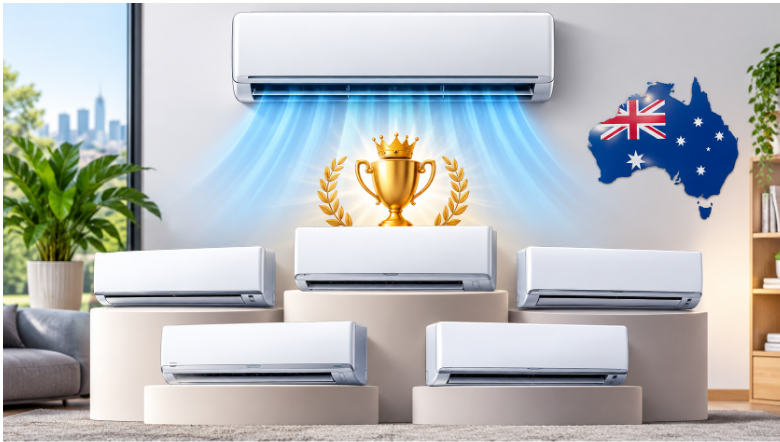
Shopping for the best wall mounted split system air conditioners in Australia can feel like wading through alphabet soup. Every brand has a dozen series, every series has a handful of kW sizes, and every spec sheet promises quiet, efficient comfort. What actually decides your result is the match between the unit, your room and the person who installs it.
This guide narrows the field to five proven choices for Australian homes in 2026. The picks reflect how reliable each brand is, how well it is supported locally, how efficient and quiet its units run, and what we see on real split system installations across Sydney.
Short on time? Here is the quick version:
- Best all-rounder: Daikin.
- Best for quiet bedrooms: Mitsubishi Electric MSZ-AP.
- Best for big living areas and long-term owner satisfaction: Mitsubishi Heavy Industries Bronte, with Avanti for smaller rooms.
- Best for low running costs and winter warmth: Panasonic Z series.
- Best for dependable performance at a fair price: Fujitsu Lifestyle.
| Rank | Brand and series | Best for | Standout feature |
|---|---|---|---|
1 |
Daikin (Alira X, Zena, Lite) |
All-round confidence |
Widest range, locally assembled, big dealer network |
2 |
Mitsubishi Electric (MSZ-AP) |
Bedrooms and quiet spaces |
Indoor noise as low as 18 dB(A) |
3 |
Mitsubishi Heavy Industries (Avanti, Bronte) |
Value and large rooms |
Long-throw airflow of up to 18 metres on the Bronte |
4 |
Panasonic (Z series) |
Low running costs |
High heating efficiency and Nanoe-G air purification |
5 |
Fujitsu (Lifestyle) |
Everyday performance |
Human Sensor and noise as low as 21 dB(A) |
This list is a shortlist, not a final verdict. Specifications differ from one model to the next, so always check the exact model before you buy.
How we picked the best reverse cycle split systems
Every system here is a reverse cycle model, so it cools in summer and heats in winter from the same unit. For most Australian homes that is the sensible default, because heating with a reverse cycle unit is typically far cheaper than running a standard electric heater.
We judged each option on five points:
- Reliability and reputation. How long the brand has been selling here and how technicians rate its build quality.
- Local support and warranty. Whether parts, service teams and clear warranty terms are easy to reach.
- Owner experience. What real households say about noise, comfort and day-to-day use.
- Efficiency and sound levels. Energy ratings and indoor noise, which matter most in bedrooms.
- Smart features. Wi-Fi, app control and voice assistant compatibility.
The 5 best split system air conditioners in Australia for 2026
1. Daikin: the best all-rounder
Best for: anyone who wants a safe, well-supported choice for almost any room.
Daikin has sold air conditioners in Australia for over five decades, and it assembles part of its range locally in Sydney. With hundreds of authorised dealers nationwide, finding parts and a technician rarely takes long. That support network is a major reason it earns the top spot on our list.
The residential range is the broadest here, from the entry-level Lite up to the designer Zena. For most households the Alira X hits the sweet spot, combining built-in Wi-Fi, Streamer air purification and quiet running.
- Strengths: huge choice of series, local assembly, strong dealer coverage, air purification.
- Trade-offs: premium pricing, and the Lite needs an optional adapter to get Wi-Fi.
- Warranty: 5 years, parts and labour.
Is the extra spend worthwhile? Our guide Is Daikin Worth the Price? weighs up durability and long-term performance. MaximAir installs Daikin across Sydney, from single rooms to ducted air conditioning for the whole house.
2. Mitsubishi Electric MSZ-AP: the quietest option for bedrooms
Best for: bedrooms, nurseries and home offices where silence matters.
With an indoor noise level as low as 18 dB(A), the MSZ-AP is close to inaudible at its lowest setting. Technicians also rate the brand’s build quality among the best in the residential market. Built-in Wi-Fi has been standard on the AP, EF and LN series since April 2025, so app control no longer means paying extra.
The 3.5 kW size suits a typical bedroom well. The styling is plain, which some people see as a plus because it blends into the wall.
- Strengths: whisper-quiet operation, premium build quality, service support in every state.
- Trade-offs: premium pricing and a simple, understated look.
- Warranty: 5 years, parts and labour.
MaximAir is a Sydney specialist for this brand. Visit our Mitsubishi Electric air conditioning specialists page to learn more.
3. Mitsubishi Heavy Industries Avanti and Bronte: strong value for owners
Best for: buyers who want proven reliability, with Avanti for small to medium rooms and Bronte for large open-plan spaces.
Mitsubishi Heavy Industries (MHI) is a separate company from Mitsubishi Electric, with its own products, warranty terms and service network. Owners tend to rate both of its popular series very highly for quiet running, sturdy build and value for money.
- Avanti: a popular pick for bedrooms, studies and mid-sized living rooms. Its newer WF1 models add built-in Wi-Fi, Google Assistant and Alexa control, plus a fine-particle filter for cleaner air.
- Bronte: made for the 7.1 to 9.5 kW range, with a long-throw fan that can carry cool air up to 18 metres. That makes it a natural fit for family rooms and open-plan living.
A Bronte in the main living area paired with smaller units in the bedrooms is a common setup. If you are cooling several rooms, our guide to multi-head split systems explains the options. You can also visit our Mitsubishi Heavy Industries specialists page for local installation.
4. Panasonic Z series: the efficiency pick
Best for: households focused on lower running costs and economical winter heating.
The Panasonic Z series, such as the 3.5 kW cooling and 4.0 kW heating CS/CU-Z35XKR, combines inverter technology with a high heating efficiency rating. That means a warm room in winter for less power. The Nanoe-G air purifying function is a welcome extra for households with allergies.
- Strengths: efficient heating, good value, built-in air purification and a feature-rich range.
- Trade-offs: the model above skips an auto shut-off function and a dedicated anti-dust filter. Always confirm the current model number and specifications before buying.
- Warranty: typically 5 years.
Efficient units can also help you qualify for incentives, so read our guide to government rebates for energy-efficient air conditioning. MaximAir’s Panasonic air conditioning specialists can quote the current range.
5. Fujitsu Lifestyle: dependable performance at a fair price
Best for: value-minded households that want a reliable, technician-friendly system.
Fujitsu focuses on air conditioning, and it shows. Its units are well built, installers know them inside out, and prices usually sit below the premium Japanese brands. The Lifestyle series is the strongest in the range, offering Human Sensor occupancy detection, an Economy mode and noise levels as low as 21 dB(A).
- Strengths: trusted by installers, competitive pricing, reliable everyday performance.
- Trade-offs: smart features are less comprehensive than on some rivals, and Wi-Fi is not standard across every model. Larger capacities may have lower energy ratings than smaller ones.
- Warranty: 5 years, parts and labour.
Ask the MaximAir team about current Fujitsu availability and how it compares with the brands we install most often.
Honourable mentions: LG and Haier
Two more brands are worth a look if the five above do not fit.
- LG: the strongest choice for smart homes, with built-in Wi-Fi, an app, and voice assistant support on every model. It also offers the longest cover in this group, with 5 years parts and labour plus an extra 5 years on the compressor. The range is compact, with only two residential series.
- Haier: a budget-friendly option with very good efficiency. The Quartz 2.5 kW reaches a 10-star cooling rating on the zoned energy label. It has a shorter air conditioning history in Australia than the Japanese brands, and some owners find its app fiddly.
For a broader look at the names Australians trust, see our guide to the most trusted air conditioning brands in Australia for 2026.
How to choose the right split system for your home
The name on the casing matters less than how well the unit suits your space. Work through these five checks before you compare quotes.
Size it correctly
Capacity is measured in kW, and bigger is not automatically better. A unit that is too large will cycle on and off constantly, wasting power and leaving the room uneven. One that is too small will run flat out and still struggle on a hot day. Room size, ceiling insulation, window area, sun exposure and climate all matter, so ask your installer to do the calculation instead of guessing.
Read the zoned energy label
Australia’s Zoned Energy Rating Label shows how a model performs in hot, average and cold climates. Sydney sits in the average zone, so that is the figure to compare. It tells you far more than a single star rating, and every new residential unit sold here also has to meet minimum efficiency standards.
Check the sound level
For a bedroom or study, look for an indoor noise figure at the low end of the scale. The quietest units in this guide drop to around 18 to 21 dB(A) on their lowest fan setting. Read the spec sheet rather than the brochure.
Decide how connected you want to be
Built-in Wi-Fi is now common, though app quality varies. If you want voice control or live energy tracking, LG and the newer Mitsubishi models are good bets. If you simply want to switch the unit on before you get home, nearly any of the five will do.
Pick single, multi-head or ducted
A single split system cools one room or one open-plan zone. A multi-head split system links two or more indoor units to a single outdoor unit, which works well for rooms that sit side by side. Ducted systems cover the entire home. Our overview of the types of air conditioners shows when each one makes sense.
What does a split system cost, and how can you pay less?
Prices range from around $600 for a small entry-level model to well over $5,000 for a large premium unit, before installation. Capacity, brand, efficiency and features all shift the price. Installation is quoted on top and depends on pipe length, wall construction, electrical work and access, so always request an itemised quote.
Three things can bring the total down:
- Choose an efficient model. A more efficient unit costs less to run over its lifetime, which can offset a higher purchase price.
- Claim available incentives. NSW households may be able to use the Energy Savings Scheme. Our guide to government rebates explains how it works, and the ESS rebate page has current details.
- Spread the cost with the NSW Home Energy Saver Loan. The program offers loans of up to $15,000 at 0% interest for eligible upgrades, and reverse-cycle air conditioners are on the list. It is open to NSW owner-occupiers and landlords who meet the income and credit rules. Our breakdown, Home Energy Saver Loan vs Paying Upfront, compares both routes with real numbers. Terms can change, so check the latest rules before you apply.
Once your system is running, regular servicing protects its efficiency. Our guide on how often to service a split system is a good place to start.
Why installation matters as much as the brand
A premium unit installed poorly will perform worse than a mid-range unit installed well. Correct sizing, sensible placement, tidy pipework and a technician who knows the product make the biggest difference to comfort and bills.
MaximAir has more than 15 years of experience supplying and installing air conditioning in Sydney. Our split system work includes:
- Right-sizing your system. We assess your rooms, insulation and layout so the unit is neither too big nor too small.
- Brand guidance. We install trusted brands including Daikin, Samsung and Mitsubishi Electric, with dedicated pages for Mitsubishi Electric, Mitsubishi Heavy Industries and Panasonic.
- Neat, careful installs. Clean pipework, a tidy site and a proper handover.
- Ongoing care. Air conditioning service and maintenance keeps your system efficient year after year.
We work across North Shore, the Hills District, the Shire and the north-western suburbs and wider Sydney. Check our service areas to see if we cover your suburb.
Not sure whether your current unit is worth keeping? Read 5 warning signs it’s time to replace your air conditioner.
Final verdict: which split system should you buy?
The best split system air conditioners in Australia each shine in a different way:
- Daikin for the safest all-round choice and deep local support.
- Mitsubishi Electric MSZ-AP for the quietest bedrooms.
- Mitsubishi Heavy Industries Avanti and Bronte for value, with Bronte built for big rooms.
- Panasonic Z series for low running costs and efficient heating.
- Fujitsu Lifestyle for dependable performance at a fair price.
Whichever you choose, correct sizing and careful installation decide how well it performs for the next 10 to 15 years. The MaximAir team can help you compare options, check rebates and the Home Energy Saver Loan, and install your system properly.
Ready for a quote? Get a free air conditioning quote or call 02 9157 5577, and we will recommend the right split system for your home.
Frequently Asked Questions
Which split system brand is best in Australia?
There is no single winner for every home. Daikin is the safest all-rounder, Mitsubishi Electric is the quietest, Mitsubishi Heavy Industries offers strong value, Panasonic leads on heating efficiency and Fujitsu delivers dependable performance for the price. Match the brand to your room, climate and budget.
What size split system do I need?
It depends on room size, insulation, windows, sun exposure and climate. Because both oversized and undersized units cause problems, ask an installer to calculate the right kW rating for your space.
Should I buy reverse cycle or cooling only?
For most homes, reverse cycle is the better buy, even if you only use heating now and then. Cooling-only models cost a little less but give up winter heating, so they suit homes that already have good heating.
How long does a split system last?
With regular servicing and clean filters, a split system commonly lasts 10 to 15 years.
Are Mitsubishi Electric and Mitsubishi Heavy Industries the same company?
No. They are separate companies with different products, warranties and service networks, so do not assume details for one apply to the other
Can I use the NSW Home Energy Saver Loan for a split system?
Yes, reverse-cycle air conditioners are on the list of eligible upgrades. The loan is 0% interest, up to $15,000, for NSW owner-occupiers and landlords who meet the income and credit rules. Read our loan vs paying upfront guide for the details, and check current eligibility before you apply.