

Conventional vs. Smart AC Zone Controller Systems: Which Ducted Air Conditioning Setup Is Right for You?
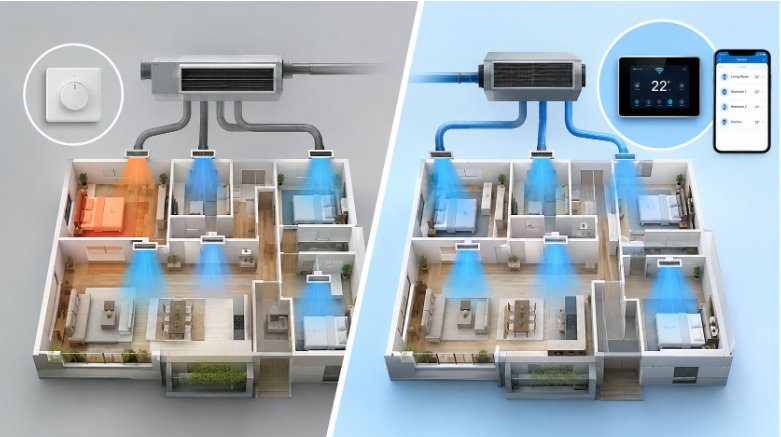
If you’ve ever walked from a cool living room into a stuffy bedroom after setting your ducted air conditioner to the same temperature, you’re not imagining it. In many Sydney homes, uneven comfort happens because a conventional zone control system relies on a single temperature sensor to make decisions for the entire house, even though every room heats and cools differently throughout the day.
At MaximAir, we help homeowners across Sydney upgrade and optimise ducted air conditioning systems for more consistent comfort and better efficiency. One of the biggest improvements available today is moving from a traditional single sensor controller to a smart multi AC zone control system that monitors each room individually and adjusts airflow automatically.
Both systems use motorised dampers to direct conditioned air to different zones, but the way they manage temperature is very different. A conventional controller works from one central temperature reading and a manually balanced setup, while a smart controller continuously monitors every zone, adjusts airflow as conditions change, and helps the system respond more accurately to real demand. Understanding these differences can help you choose the right solution for your home, budget, and comfort goals.
How Conventional Air Conditioner Zone Controller Systems Work
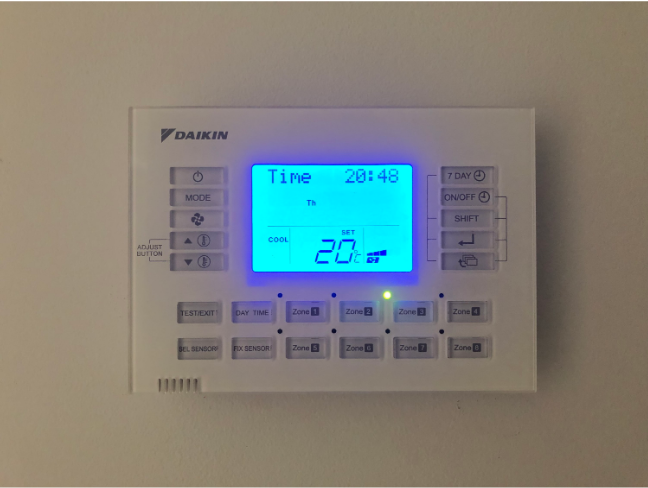
A traditional ducted air conditioning setup typically uses a single wall-mounted controller, usually installed near a central return air grille, along with individual on/off switches for each zone. The wall controller houses the system’s only temperature sensor, and every zone that’s switched on is conditioned based on that one reading.
During installation, the technician will manually balance airflow to each zone by adjusting the dampers at the hardware level, aiming for a reasonable spread of conditioned air across the home.
Pros
- Lower upfront cost — this is generally the most affordable ducted air conditioning zoning option available.
- Simpler installation — fewer components and a more straightforward setup for the installer.
Cons
- One sensor governs the whole home. Every zone is conditioned based on the temperature at a single point, regardless of what’s actually happening elsewhere.
- Uneven comfort. A room with heavy afternoon sun exposure, poor insulation, or its own thermal quirks can sit well above or below the set point on the controller, even though the controller itself reads the “right” temperature.
- Inefficient run cycles. Because the system can’t see conditions in every zone, it often keeps running longer than necessary in some rooms while barely reaching target in others — the compressor works off incomplete information.
- Balance drifts with the seasons. Manual air balancing is done once, at installation. As seasonal heat loads, sun angles, and usage patterns change throughout the year, that initial balance becomes progressively less accurate.
How Modern Smart Zone Controllers Work
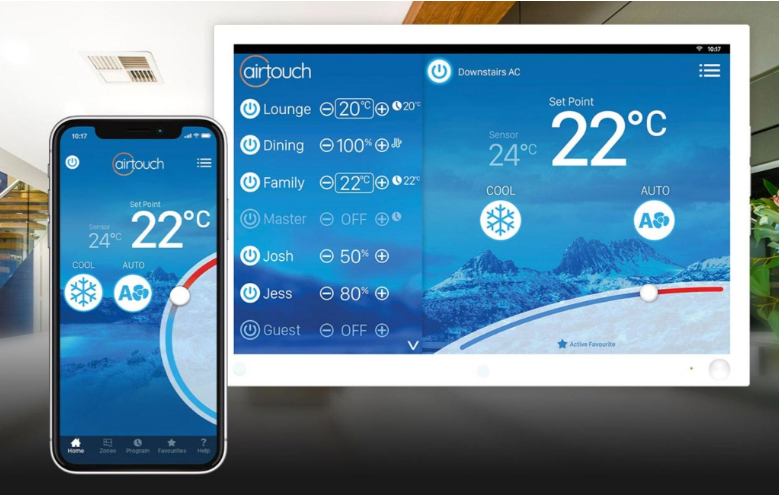
Smart zone control systems take a fundamentally different approach: instead of one sensor, each zone gets its own dedicated temperature sensor, all reporting back to a central smart controller (often paired with an app for remote access and scheduling).
This gives the system continuous, real-time visibility into every zone rather than a single snapshot from one location. The controller uses that data to adjust the motorised dampers in each zone, opening or closing them to match the airflow each room actually needs, while the compressor’s output is modulated based on total system demand rather than a single reading.
It’s worth noting that how independently each zone can be controlled depends on the type of air conditioning system underneath the zoning. In a standard ducted split system with one compressor, all active zones still share that one unit’s conditioned air output — the smart controller is optimising how that shared output is distributed and how hard the compressor needs to work, rather than running each room as a fully separate air conditioner. True independent temperature and mode control per zone is only possible with multi-split or VRF (Variable Refrigerant Flow) systems, which use multiple indoor units. That said, even within a single-compressor ducted system, zone-level sensing is a significant upgrade over a single wall controller, because the system can prioritise, sequence, and balance zones intelligently instead of guessing.
Pros
- Zones get much closer to their actual set point, since each one is measured directly rather than inferred from a reading taken elsewhere in the house.
- Better-matched system output. With visibility into demand across every zone, the compressor can modulate more precisely instead of over-running in some areas and under-running in others — this generally translates into better energy efficiency.
- Continuous, automatic air balancing. Dampers adjust dynamically as conditions change through the day and across seasons, rather than relying on a single manual balance set at installation.
- Richer scheduling and control. Most smart systems support zone-specific schedules, time-based programs, and app-based control, so different rooms can run on entirely different routines.
Cons
- Higher upfront cost, reflecting the additional sensors, wiring or wireless hardware, and the smart controller itself.
- More complex installation and setup. Getting the full benefit requires an installer who understands how to configure the system properly — poor setup can undermine the advantages the hardware is designed to deliver.
Which System Should You Choose?
For a smaller home with fairly consistent sun exposure and insulation across rooms, a conventional single-sensor controller can still do an adequate job at a lower price point. But for larger homes, homes with mixed orientations (a north-facing living room versus a shaded south-facing bedroom, for example), or households where different people want different temperatures in different rooms, a smart multi-zone system generally delivers a noticeably more even and efficient result over the life of the system.
The best way to decide is to have a licensed air conditioning technician assess your home’s layout, insulation, and sun exposure, and quote both options so you can weigh the price difference against the comfort and efficiency gains for your specific space.
Considering an upgrade from a single-sensor wall controller to a fully zoned smart system? Talk to us about assessing your home and comparing both options against your budget and comfort goals.
Frequently Asked Questions
1.What is a smart zone controller?
A smart zone controller is an advanced control system for ducted air conditioning that uses a temperature sensor in each zone instead of relying on one central sensor. It automatically adjusts airflow based on the conditions in each room and often includes app based control and scheduling.
2.Can I upgrade an existing conventional system to a smart multi-zone controller?
In many cases, yes, but it depends on your existing ductwork, dampers, and compressor compatibility. A qualified technician can assess whether your current system supports an upgrade or whether additional hardware changes are needed.
3.Can every room have its own temperature?
Yes given the zoning is done at a granular room level each room can have its own temperature within a few degrees off the set point and most of the time this is configurable within the main controller to control the offset threshold.
4.Can other types of new or existing AC systems be integrated into a smart controller? (e.g. Cassette or wall mounted systems)
Yes, its possible to bring the entire air conditioning systems in a home or office into the Smart Controller platform and make it work like a central controller, this becomes quite useful when there is large number of systems and there needs to be scheduling and restrictions applied to each system.